Treadmill gradient chart: percent, degrees and climb
The gradient compares the climb with the horizontal distance, so 10% is 5.7°. Some consoles show levels instead of a percentage; the manual gives the conversion.
On a route, elevation gain adds up every climb. Two routes with the same gain can feel very different: one climbs gently from start to finish, the other packs it all into one short hill. Look at the profile before you choose.
| Grade | Angle | Climb per km | Climb per mile |
|---|---|---|---|
| 1% | 0.6° | 10 m | 53 ft |
| 2% | 1.1° | 20 m | 106 ft |
| 3% | 1.7° | 30 m | 158 ft |
| 4% | 2.3° | 40 m | 211 ft |
| 5% | 2.9° | 50 m | 264 ft |
| 6% | 3.4° | 60 m | 317 ft |
| 7% | 4.0° | 70 m | 370 ft |
| 8% | 4.6° | 80 m | 422 ft |
| 9% | 5.1° | 90 m | 475 ft |
| 10% | 5.7° | 100 m | 528 ft |
| 12% | 6.8° | 120 m | 634 ft |
| 15% | 8.5° | 150 m | 792 ft |
| 20% | 11.3° | 200 m | 1,056 ft |
Why set 1% on the flat
On a treadmill you don’t push through air, so the same speed takes a little less effort than outside. In 1996, Andrew Jones and Jonathan Doust found that a 1% grade made up the difference for nine trained runners, between 10.5 and 18 km/h (6.5 to 11.2 mph), over efforts of about 5 minutes.
The study says nothing about slower paces, where air resistance matters less. So 1% is a practical convention, tested for easy to fast running paces.
Further reading: Jones and Doust, Journal of Sports Sciences, 1996 ↗
12-3-30: 30 minutes of walking at 12%
12-3-30 was popularized by influencer Lauren Giraldo, on YouTube in 2019 and then on TikTok in 2020: a 12% incline, 3 mph (4.8 km/h), for 30 minutes. It’s walking, but the incline makes it a sustained effort: per minute, it costs as much energy as a flat run at 4.5 to 4.7 mph, as the 12-3-30 vs running guide works out.
The trainers Healthline spoke to recommend building up to it; one suggests starting with 20 minutes at 4% and 2.5 mph. You also need a treadmill that goes up to 12%.
The Runkyz Incline walking plan gets you there in four weeks, with three sessions a week, through these stages:
| Step | Incline | Duration |
|---|---|---|
| Stage 1 | 8% | 20 min |
| Stage 2 | 10% | 25 min |
| Stage 3 | 11% | 28 min |
| Goal: 12-3-30 | 12% | 30 min at 4.8 km/h (3 mph) |
Further reading: Healthline — What experts think of 12-3-30 ↗
Two running hill workouts
When running, hills are trained as repeats, with a recovery between climbs. Runkyz offers two:
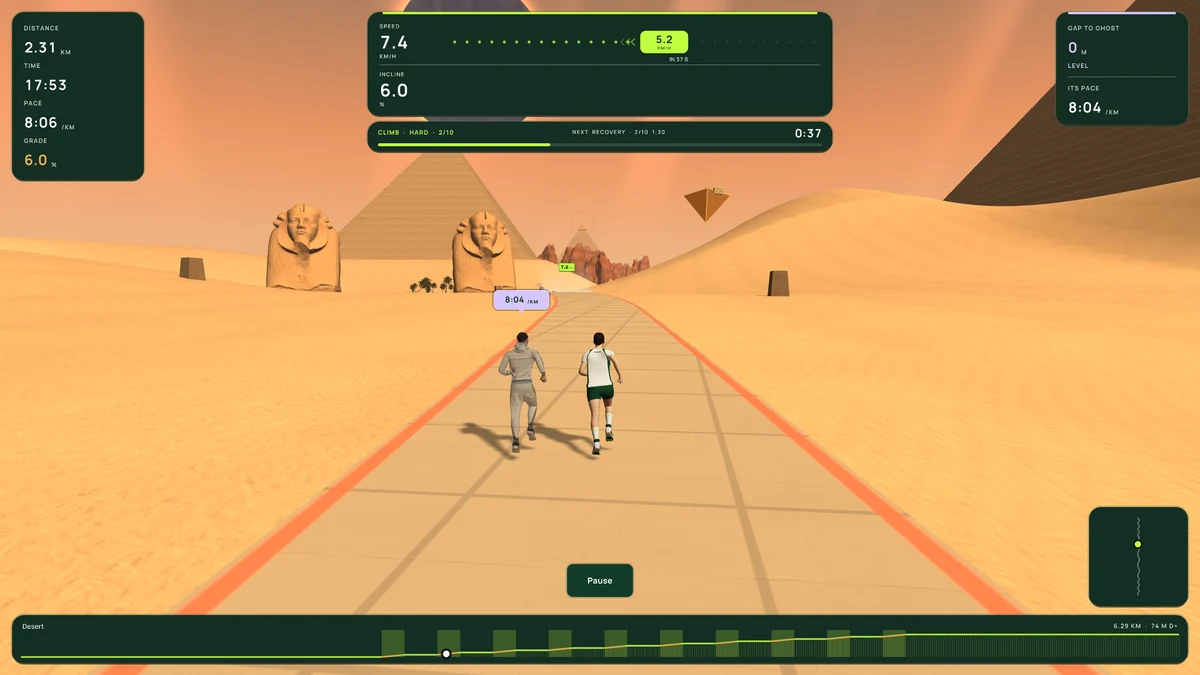
- Dune hills: 6 climbs of 3 minutes at 5%, to learn to hold a long effort.
- Short hills: 10 one-minute climbs at 6%, harder, with the cue “hard, a few words”.
When the route is steeper than your treadmill
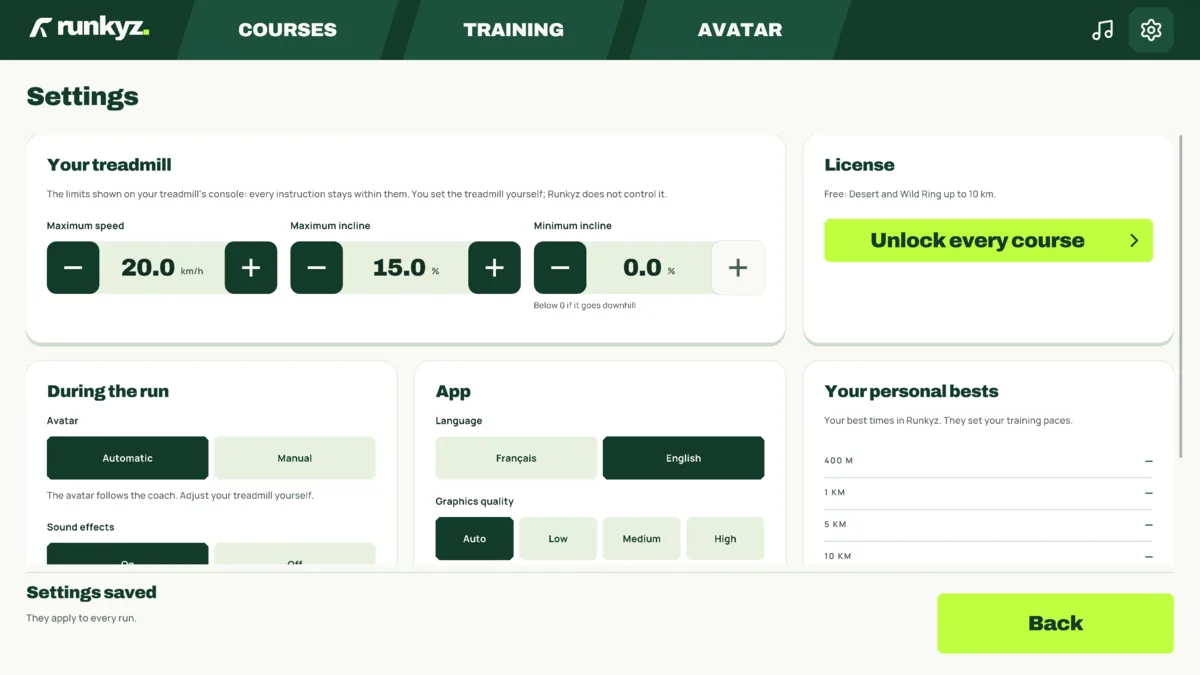
A virtual route can climb more steeply than your treadmill’s maximum incline. Enter its real limits in the settings: Runkyz will never ask for more, and will make up for a grade that’s too steep with a little more speed, without going over the maximum speed you entered.
That compensation is an approximation: a treadmill that stops at 10% doesn’t reproduce a 20% climb, and one that can’t go below 0% doesn’t reproduce descents.
Open the settings
Click the gear icon at the top right of the menu, then find the Your treadmill card.
Enter the maximum speed
Use the value from the manual or the console: no target will go above it.
Enter the maximum and minimum incline
The minimum incline goes below 0 only if your treadmill declines; otherwise, leave it at 0%.
Choose a route by its terrain
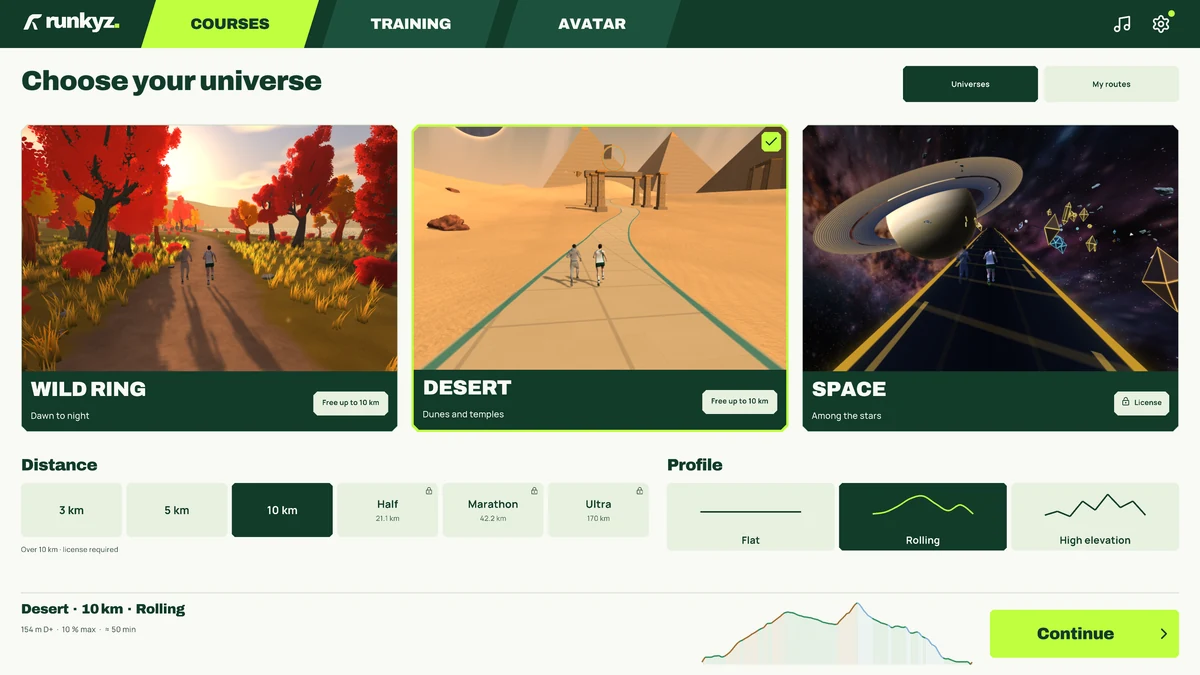
The Courses menu puts numbers on the terrain before you start. On Desert with the rolling profile: 78 m of elevation gain and a 9% steepest grade over 5 km, 154 m and 10% over 10 km. Wild Ring stays flat, whatever the distance.
Desert and Space come in flat, rolling or high-elevation profiles. Desert and Wild Ring come with 3 free runs up to 10 km; Space and longer distances need the license.
IN RUNKYZ
The Incline walking plan is in Runkyz.
Four weeks of stages up to 12-3-30, with targets that stay within your treadmill’s limits.