
What VMA is and how long you can hold it
VMA, or vVO2max, is the running speed at which the body consumes its maximum oxygen, its VO2max. Most athletes can hold it for four to eight minutes, and it is used to predict performance over efforts of 5 to 10 minutes. Short intervals around it are a classic session.
The Léger-Mercier formula links the two: VMA in km/h equals VO2max in ml/kg/min divided by 3.5.
Further reading: Wikipedia — Vitesse maximale aérobie (in French) ↗
The Runkyz test, minute by minute
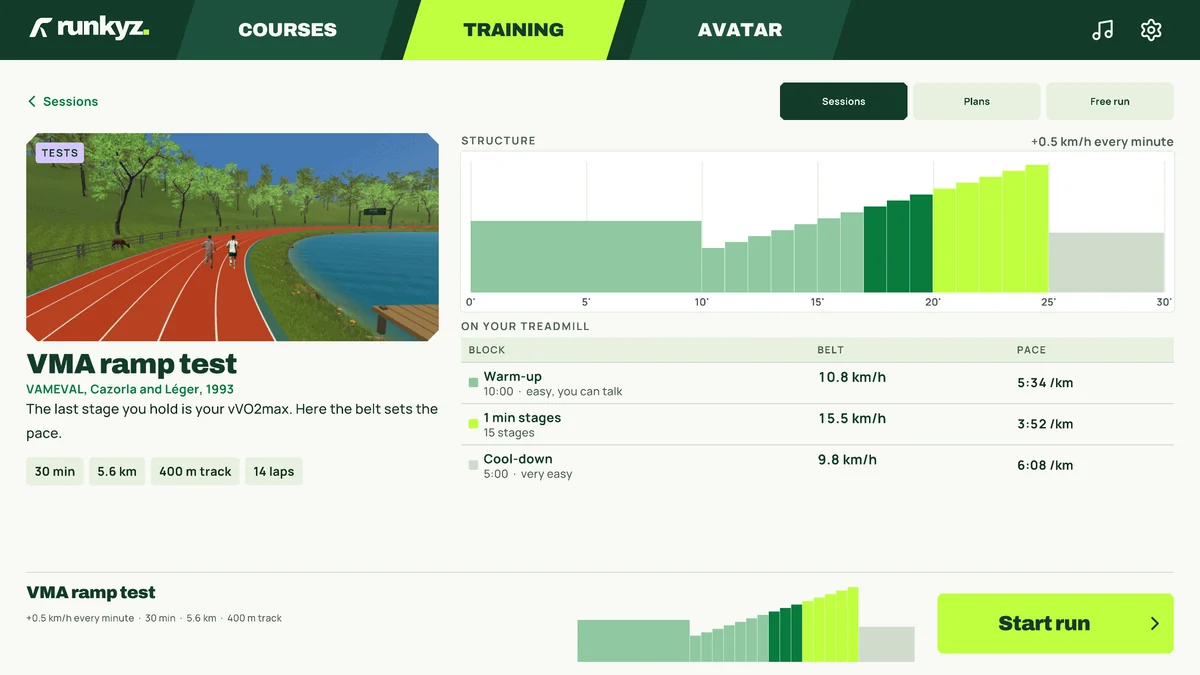
The test follows the VAMEVAL, which Georges Cazorla and Luc Léger published in 1993. Published descriptions start at 8 or 8.5 km/h depending on the source; Runkyz starts its stages at 8.5 km/h.
Warm up for 10 minutes
The session opens with 10 easy minutes.
Follow the stages
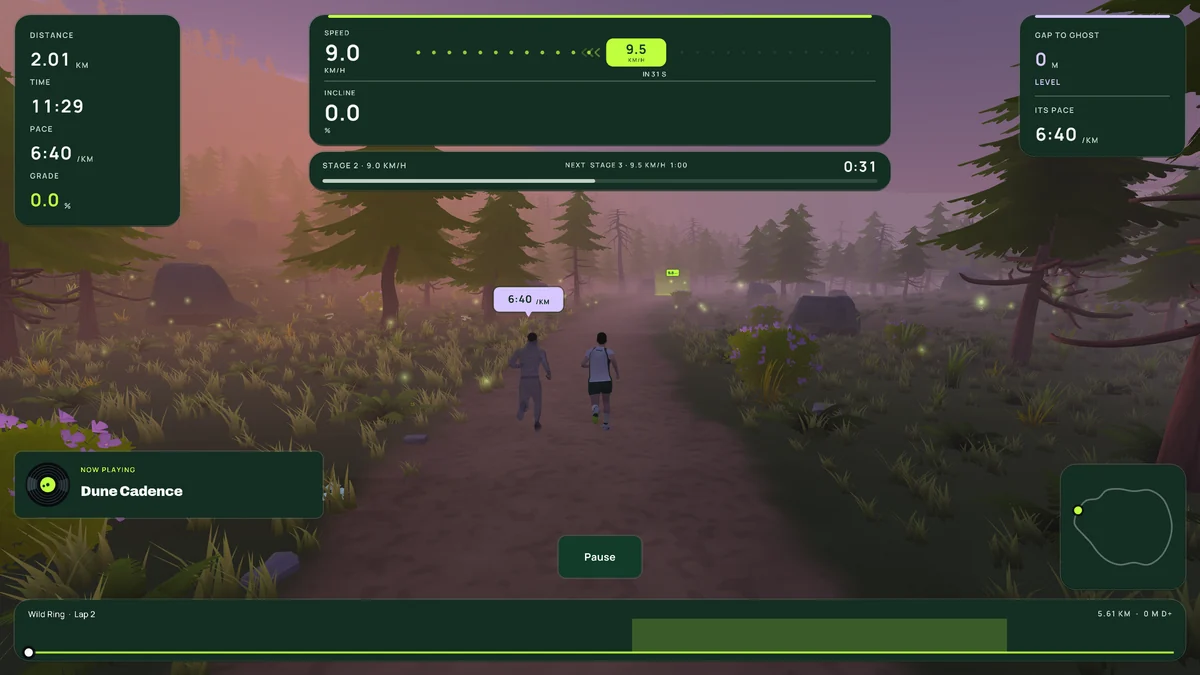
The belt goes up by 0.5 km/h every minute. The banner announces the next stage in advance, so you have time to press the button on the console.
Stop when you cannot follow
The last full stage you held is your VMA. Note its speed.
Cool down for 5 minutes
The session ends with 5 very easy minutes.
Before you start
The test is a maximal effort. Do it rested, after a few weeks of regular running, and clip the safety key to your clothes. If you have any doubt about your health, ask a doctor first.
A belt has no air resistance, so the same speed costs a little less effort than outdoors. Jones and Doust found that a 1% incline made up the difference for nine trained runners between 10.5 and 18 km/h. The Runkyz ramp runs at 0% incline: your result may sit slightly above what a track test would give you.
Further reading: Jones and Doust, Journal of Sports Sciences, 1996 ↗
VMA pace chart: belt speed from 60 to 105%
A training plan often gives its paces as a percentage of VMA. On a treadmill that percentage becomes a speed to set: multiply your VMA by the percentage. At 80% of a 15 km/h VMA, the belt runs at 12 km/h.
Wikipedia places the efforts of an interval session between 95 and 110% of VMA. The speeds in the chart are rounded to 0.1 km/h.
| VMA | 60% | 70% | 80% | 85% | 90% | 95% | 100% | 105% |
|---|---|---|---|---|---|---|---|---|
| 10 km/h | 6.0 | 7.0 | 8.0 | 8.5 | 9.0 | 9.5 | 10.0 | 10.5 |
| 11 km/h | 6.6 | 7.7 | 8.8 | 9.4 | 9.9 | 10.5 | 11.0 | 11.6 |
| 12 km/h | 7.2 | 8.4 | 9.6 | 10.2 | 10.8 | 11.4 | 12.0 | 12.6 |
| 13 km/h | 7.8 | 9.1 | 10.4 | 11.1 | 11.7 | 12.4 | 13.0 | 13.7 |
| 14 km/h | 8.4 | 9.8 | 11.2 | 11.9 | 12.6 | 13.3 | 14.0 | 14.7 |
| 15 km/h | 9.0 | 10.5 | 12.0 | 12.8 | 13.5 | 14.3 | 15.0 | 15.8 |
| 16 km/h | 9.6 | 11.2 | 12.8 | 13.6 | 14.4 | 15.2 | 16.0 | 16.8 |
| 17 km/h | 10.2 | 11.9 | 13.6 | 14.5 | 15.3 | 16.2 | 17.0 | 17.9 |
| 18 km/h | 10.8 | 12.6 | 14.4 | 15.3 | 16.2 | 17.1 | 18.0 | 18.9 |
| 19 km/h | 11.4 | 13.3 | 15.2 | 16.2 | 17.1 | 18.1 | 19.0 | 20.0 |
| 20 km/h | 12.0 | 14.0 | 16.0 | 17.0 | 18.0 | 19.0 | 20.0 | 21.0 |
Further reading: Wikipedia — Vitesse maximale aérobie (in French) ↗
What to do with your VMA
Sessions near your VMA are short intervals: Runkyz has Billat 30/30, 10 × 400 m, the Pyramid and Yasso 800s in its VMA family. The table converts a VMA into the pace and the 400 m lap time at 100% of it.
| VMA | Pace per kilometer | 400 m lap |
|---|---|---|
| 10 km/h | 6:00 | 2:24 |
| 12 km/h | 5:00 | 2:00 |
| 14 km/h | 4:17 | 1:43 |
| 16 km/h | 3:45 | 1:30 |
The paces Runkyz sets from your VMA
Runkyz converts the last stage you held into a VDOT, the index of Jack Daniels and Jimmy Gilbert (1979), and sets each zone at a share of that oxygen uptake: the easy pace comes out near 75% of VMA, threshold near 90%.
The table gives the belt speed of five zones as the game shows them, on the flat and to the nearest 0.1 km/h. The marathon and 5 km paces are those of the times the same index predicts over those distances.
| VMA | Recovery | Easy | Marathon pace | Threshold | 5 km pace |
|---|---|---|---|---|---|
| 10 km/h | 6.9 | 7.6 | 8.4 | 9.0 | 9.4 |
| 11 km/h | 7.6 | 8.3 | 9.3 | 9.9 | 10.4 |
| 12 km/h | 8.2 | 9.0 | 10.1 | 10.8 | 11.4 |
| 13 km/h | 8.9 | 9.8 | 11.0 | 11.7 | 12.4 |
| 14 km/h | 9.5 | 10.5 | 11.8 | 12.6 | 13.4 |
| 15 km/h | 10.2 | 11.2 | 12.7 | 13.5 | 14.4 |
| 16 km/h | 10.9 | 12.0 | 13.6 | 14.4 | 15.4 |
| 17 km/h | 11.6 | 12.7 | 14.5 | 15.3 | 16.4 |
| 18 km/h | 12.2 | 13.5 | 15.4 | 16.2 | 17.5 |
| 19 km/h | 12.9 | 14.2 | 16.3 | 17.1 | 18.5 |
| 20 km/h | 13.6 | 15.0 | 17.2 | 18.0 | 19.5 |
Estimate your VMA without a ramp test: a race time is enough
Runkyz also recalculates every pace from a 5 km time. After that, your best times in the game, from 400 m to the marathon, keep your paces up to date as you improve.
The table reads both ways. A VMA of 14 km/h matches 22:25 over 5 km and 46:28 over 10 km; in the other direction, a 10 km run in 50 minutes points to a VMA close to 13 km/h. These are equivalents calculated with the same VDOT formula: the marathon time assumes you have trained for that distance.
Another estimate is the half-Cooper test: run for 6 minutes at a steady pace, as far as you can. The distance in meters divided by 100 is your average speed in km/h, an estimate of your VMA: 1,400 m gives 14 km/h.
| VMA | 5 km | 10 km | Half marathon | Marathon |
|---|---|---|---|---|
| 10 km/h | 31:52 | 1:06:17 | 2:26:41 | 5:00:26 |
| 11 km/h | 28:51 | 59:57 | 2:12:51 | 4:33:10 |
| 12 km/h | 26:20 | 54:42 | 2:01:16 | 4:10:15 |
| 13 km/h | 24:13 | 50:15 | 1:51:27 | 3:50:43 |
| 14 km/h | 22:25 | 46:28 | 1:43:01 | 3:33:52 |
| 15 km/h | 20:50 | 43:13 | 1:35:44 | 3:19:11 |
| 16 km/h | 19:28 | 40:22 | 1:29:22 | 3:06:17 |
| 17 km/h | 18:16 | 37:52 | 1:23:45 | 2:54:52 |
| 18 km/h | 17:11 | 35:39 | 1:18:47 | 2:44:41 |
| 19 km/h | 16:13 | 33:41 | 1:14:21 | 2:35:34 |
| 20 km/h | 15:22 | 31:54 | 1:10:22 | 2:27:21 |
Further reading: Wikipedia — the half-Cooper test (in French) ↗
IN RUNKYZ
The VMA ramp test is in Runkyz.
It runs on Wild Ring: do it once and the game calculates the pace of every session. Started first, it is your free session.